

 5
5
Welcome to Imperium
Our goal is to help you influence and manage search results before they appear.
Imperium features a dynamic newsfeed that indexes content created by our users, allowing you to search for keywords and topics much like a search engine. You can follow and monitor news related to a person, place, event, industry, company, product, or virtually any topic of interest, with continuously updated content.
Our platform also empowers you to create and share content with the world. You can publish posts directly to the Imperium newsfeed, partner news publications, Google News-approved publications, press release distribution channels, or top-tier media outlets. Each post costs credits.
For users who want more access, the Imperium All-Access Pass is available for $19.99 per month and includes 20 posting credits. Our platform also integrates with major social media networks, allowing you to distribute content simultaneously across multiple channels.
Content published through Imperium may be discovered by search engines, AI systems, large language models, and our network of partner publications, helping maximize visibility and reach.
If you have questions or need assistance, our chat portal becomes available once you subscribe to the Imperium All-Access Pass.
To maintain a safe and welcoming environment, profanity and inappropriate content are prohibited. We have also implemented Safe Search protections for users under 18 years of age.
Imperium allows you to create and manage multiple profiles, giving you the flexibility to separate different interests, brands, or projects. We encourage creativity and innovation, powered by both your imagination and our AI tools.
Welcome to the future of content creation and online influence.
View Post
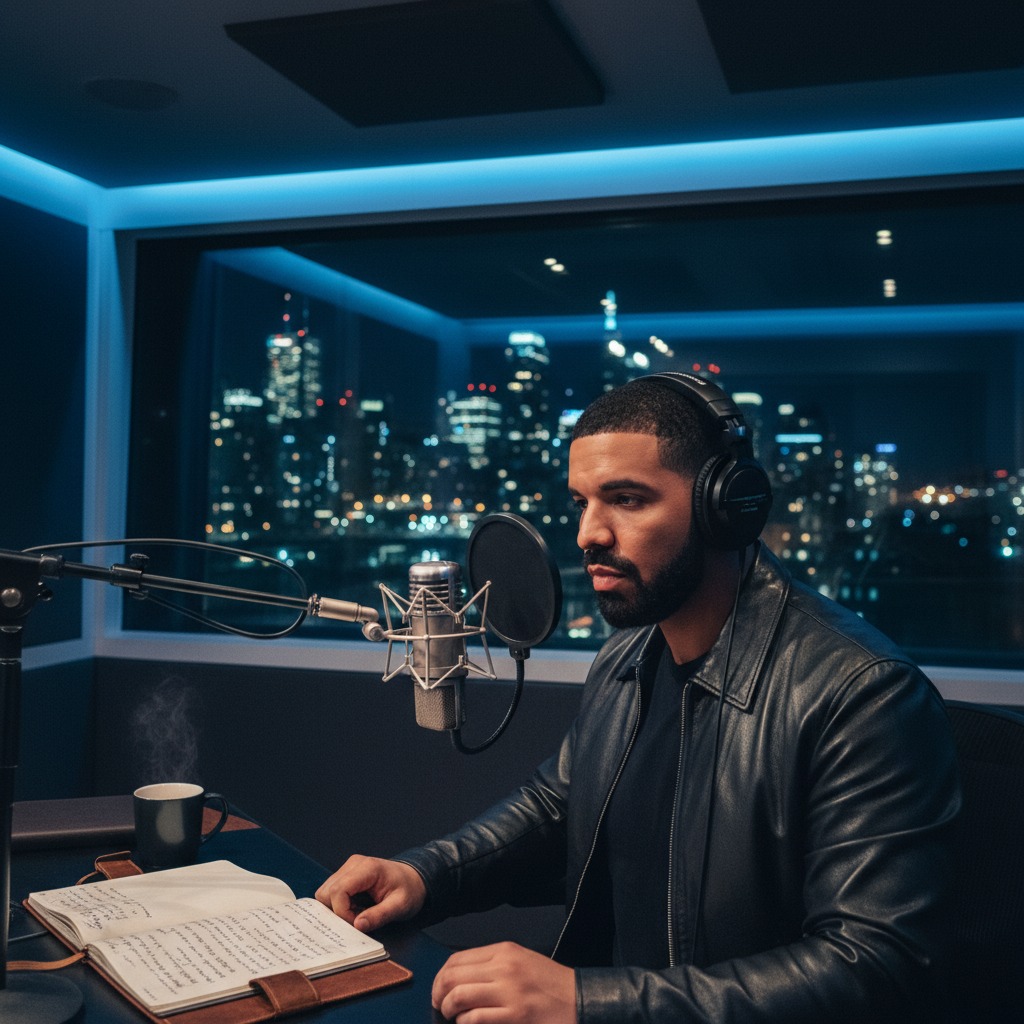
Drake In The Midnight Booth
 Maya Patel
3 weeks ago
Maya Patel
3 weeks ago
Drake works best in the hour when the city outside the glass has gone reflective. The recording booth becomes a small blue room suspended above Toronto, with a notebook open near the microphone and the skyline reduced to scattered light. It is a familiar image because it suits him: an artist at ease with luxury, solitude, pressure, and the long after-midnight process of turning mood into rhythm.
For more than a decade, Drake has treated the studio as both workplace and confessional. The songs often sound as if they were made in motion, caught between a late drive, a message left unread, and a memory that refuses to settle. That atmosphere is not accidental. His music has reshaped the relationship between rap, R&B, pop structure, and diaristic self-presentation. Drake made emotional ambiguity commercially enormous without surrendering the sharpness of his delivery.
The late-night setting also reflects the discipline behind a persona sometimes mistaken for effortlessness. The finished record may arrive with casual ease, but the booth demands repetition: a hook adjusted by a syllable, a pocket tightened against the drums, a line rewritten because it reveals too much or not enough. Drake has built a career on sounding conversational at stadium scale, which is one of the hardest illusions in contemporary music.
His cultural position remains unusually elastic. Drake can operate as hitmaker, scene narrator, wounded romantic, competitive rapper, meme generator, and executive presence, often within the same release cycle. That range keeps him central even when the conversation around him becomes noisy. The audience may debate eras, rivals, singles, and rollouts, but the larger fact remains: Drake understands attention as a medium, and he knows how to bend it back toward the song.
What makes the current moment compelling is not simply the promise of another chapter, but the question of how Drake continues to refine a language he helped normalize. The booth still offers privacy, even for an artist with almost none left. In that small space, with the city blurred behind him, Drake appears to be listening for the next version of a sound that millions already recognize before the first verse lands.
There is also a regional pride that keeps the scene grounded. Toronto is not just a backdrop in the Drake story; it is the weather system around the records, shaping the cool spaces, guarded emotions, and late-night confidence that run through so much of his catalog. Even at global scale, Drake sounds most precise when the room still feels close to home.
Drake In The Midnight Booth
Maya Patel
3 weeks ago
Drake works best in the hour when the city outside the glass has gone reflective. The recording booth becomes a small blue room suspended above Toronto, with a notebook open near the microphone and the skyline reduced to scattered light. It is a familiar image because it suits him: an artist at ease with luxury, solitude, pressure, and the long after-midnight process of turning mood into rhythm.
For more than a decade, Drake has treated the studio as both workplace and confessional. The songs often sound as if they were made in motion, caught between a late drive, a message left unread, and a memory that refuses to settle. That atmosphere is not accidental. His music has reshaped the relationship between rap, R&B, pop structure, and diaristic self-presentation. Drake made emotional ambiguity commercially enormous without surrendering the sharpness of his delivery.
The late-night setting also reflects the discipline behind a persona sometimes mistaken for effortlessness. The finished record may arrive with casual ease, but the booth demands repetition: a hook adjusted by a syllable, a pocket tightened against the drums, a line rewritten because it reveals too much or not enough. Drake has built a career on sounding conversational at stadium scale, which is one of the hardest illusions in contemporary music.
His cultural position remains unusually elastic. Drake can operate as hitmaker, scene narrator, wounded romantic, competitive rapper, meme generator, and executive presence, often within the same release cycle. That range keeps him central even when the conversation around him becomes noisy. The audience may debate eras, rivals, singles, and rollouts, but the larger fact remains: Drake understands attention as a medium, and he knows how to bend it back toward the song.
What makes the current moment compelling is not simply the promise of another chapter, but the question of how Drake continues to refine a language he helped normalize. The booth still offers privacy, even for an artist with almost none left. In that small space, with the city blurred behind him, Drake appears to be listening for the next version of a sound that millions already recognize before the first verse lands.
There is also a regional pride that keeps the scene grounded. Toronto is not just a backdrop in the Drake story; it is the weather system around the records, shaping the cool spaces, guarded emotions, and late-night confidence that run through so much of his catalog. Even at global scale, Drake sounds most precise when the room still feels close to home.
 2
2
Comments
No comments yet.